I was fixing this professor’s computer, and we got along great. I was one of only two Unix support personnel at the university and he was a Unix user. He was also from Turkey and made me Turkish Coffee every time I came to his office, so I put that guy at the top of the priority list.
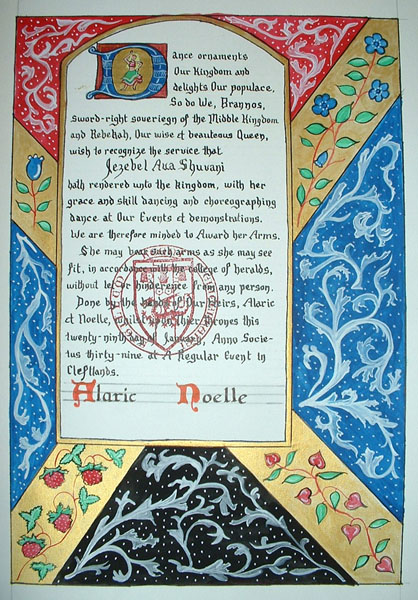
Anyway, one of our last times together, as we were waiting for a progress bar and sipping our coffee, I showed him my hobby. I was working on painting reproduction illuminated manuscript pages for awards in the Society for Creative Anachronism. You just take the bible verses or whatever out and leave blank space for award text and bam, someone gets an awesome award certificate. I was very proud of my work. I was about halfway through making a copy of every page of the Visconti Hours.
Turkish Coffee Professor’s response was not what I expected. He looked appalled. “You do this when there is suffering in the world? You waste time and resources on this when there is hunger?”
I stared at him and did NOT say, “Bitch, you are a THEATER professor.” I was too floored by the concept. I felt guilty and embarrassed that I had never considered that my efforts could be making the world better, instead of making comfortably well-off people happier to receive an award from other comfortably well-off people.
Am I doing enough to help the most needy? It’s a question that hurts, and bothers, and I’m thinking about it a lot now as I go through my book tour, spending most of my income, honestly, on traveling to opulent conventions to convince well-off people to add my book to their many possessions, so that I might sell more books to bigger publishers, in search of fame or recognition or something.
Is it all to answer my father’s “I never made anything of my life” with something he could be proud of? I digress. We could be here all day with my work-ethic emotional baggage.
The question of the role of art vs. human suffering is especially poignant now, as it feels like so much suffering is happening, worse and more and in our faces. Genocide is happening in Palestine and I’m sitting here trying to sell books?
So, in an effort to make myself, at least, feel better, I thought I would address this question, and offer three potential perspectives: the logic of false equivalence, the question of high vs. low art, and the potential value of art.
False Equivalence
Time I’m spending on my art is not, in fact, time I was planing on using to save the world. That is the brutal truth. If I had not painted those award scrolls or written those novels, I would have most likely been spending the time goofing off online or reading books.
How much of one’s free time dedicated to making the world a better place is expected? All of it? All of it, after self-care? Ten percent, like a church tithe?
Here are the things I do regularly in an attempt to Help People:
- Give to charities at a greater percentage of my income than any billionaire
- Donate to individuals in need when I can afford it without negatively impacting my family
- Carry loose dollars to give to panhandlers
- Pick up litter when I see it, or at least once a week on a dedicated litter-walk
- Knit items for donation
- Stay politically involved and bother my politicians at least once a month
- Volunteer for political, labor, and environmental causes in my area
I have not done a study to see what percentage of my time goes to these activities. I’d add signing petitions and sharing them online, but who knows if that even helps? The point is, this is what I am doing to help, and it is not at the cost of having time to enjoy my hobbies. Yes, time is a zero-sum game, but one shuffles and prioritizes on the fly. I’m as likely to take time away from family, chores, entertainment, or day-job to do good in the world as I am to take it away from creating art.
No one says, “How can you waste time mopping your kitchen when there is suffering in the world?” Perhaps this is because we all understand the value of a clean home? Which brings me to…
High Vs. Low Art
I suspect that what my theater professor friend really objected to was the “low” art of my medieval manuscripts. After all, he seemed to have no trouble prioritizing art as an activity to do while there is suffering in the world, if that art was producing and studying stage plays.
Certain types of art are considered more valuable by society. As a society, we express this value by rewarding and compensating some forms of art more than others. Literary fiction is considered more worthy than genre fiction, even if the literary novel might be shallow and the genre novel deep. Acting is seen as more worthy than juggling. Copying is seen as less worthy than composing new images. It is very clear that my amateurish paintings were not breaking new ground in the world of paint nor illustration.
But does “high” art really do more to alleviate human suffering than “low”? I find it hard to come up with any answer other than “no.” The same arguments against low art apply to high: it takes time that could be put to better use, it is extra, frivolous, and unavailable to those in extreme need.
Perhaps it could be argued that studying stage plays added more to the sum total of human knowledge than studying a particular book of hours. More people would see his plays or read his books than would get my hand-made copies of manuscripts.
Which brings us to utility.
What is the purpose of art?
Art is not useless. It can be used to:
- Entertain
- Earn capital
- Increase resilience (Self care)
- Raise awareness
- Provoke Thought
Entertainment alleviates suffering directly, providing joy, beauty, or respite.
Earning money may alleviate suffering, of the artist directly, or depending on the use the artist puts to their cash.
Emotional and mental resilience benefits from the act of making art, because it can be relaxing, calming, and healing. This mostly benefits the artist themself, same as earning money, but doesn’t that free up the artist to do more good, having prevented burnout through therapeutic doodling?
Raising awareness and provoking thought don’t directly alleviate suffering, but they may influence society to stop doing stupid shit like genocide?
Despite being the most indirect, it is these last two uses of art that I find the most compelling argument for “wasting” my time on it. Time and again, lately, I sit dismayed before a doom-scroll, and tell myself, “I will try to change minds with my writing. That’s the best thing I can do right now.”
Is it the best thing, though? Shouldn’t I rather quit my job, sell my possessions, and take to the seas as some sort of philanthropic masked vigilante?
Yes, I am picturing the reaction of my family should I enact this daydream. It’s mostly my dad and husband looking horrified and making emergency calls to my therapist. So, for now, I will continue to make art, donate to just causes, and volunteer where I can. It feels uncomfortably “reasonable” and “sane” for such insane times, but it does have the advantage of being sustainable.
And you don’t want to see the mess I become if I don’t get my art-making on.