Topic suggested by Tod Detre
Many fiction writers assume they’ll be a good dungeon master. “That adventure we just played had such a simple plot! An old man sends us into an abandoned labyrinth for a lost gem? Where’s the twist? I can do muuuch better.”
I was one such writer. I came up with a concept, outlined an elaborate plot with reversals and intrigue, drew some maps, made a dozen fascinating, nuanced Non-Player-Characters, and called up my friends to play, sure they were going to have the adventure of a lifetime.
Only to discover that my subtle clues were too subtle, my blatant clues too blatant, and the party just would NOT take the plot-bait.
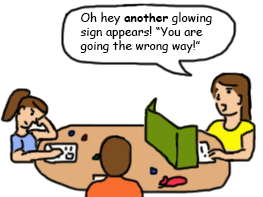
A past dungeon master I’d played with had used sweet little old ladies with pies in hand to give information to the party, making it easy for us to identify a non-threatening person. So I tried that – and the party was suspicious! “She’s too sweet, and this town is evil, let’s attack!” (The town was not evil.)
How had I failed so badly? I couldn’t transfer to the players simple clues about who was a protagonist, never mind all my detailed world-building!
Skill in writing fiction is not the same as skill in running a roleplaying game. The goal is, in fact, quite different. The fiction writer is an all-powerful god creating in her own private realm. The dungeon master is a facilitator and hostess, entertaining and catering to her players.
So, what did I learn from my disastrous years as a game master?
Manage Risk
How characters in fiction approach risk: they will do what the plot demands, including make decisions against their own safety. In fact, protagonists in action fiction are almost all risk-takers to an alarming extent. They run at danger like it’s their favorite treat. One imagines their parents in a constant state of worry.
How players in D&D approach risk: they will put their own safety above all other considerations, because they want their character, whom they spent a lot of time rolling up and creating, to survive. They won’t take the smallest risk if they can help it.
Getting my characters to care about the fate of the magic school or defeating their enemies always had to balance out against the fact that they could see easy ways to avoid danger. The source of the bad stuff is that cave north of town? Well, we sure as heck aren’t going THERE! (But my dungeon! All those traps and puzzles! SOB!)
The lesson: know what your reader/player is willing to risk and what they aren’t. You have to build up their motivation to move a certain way. Maybe it’s treasure, maybe it’s knowledge, maybe it’s saving a kitten, but you have to give them a reason, which leads me to…
Players and Characters Both Need Clear Goals
In a short story, “Go get a gem in this dungeon” is not motivating, but in a D&D group it is, because it is a simple, clear goal.
I wanted my party to unpick the mystery of why the town of Three Walls had outlawed magic, but instead they moved immediately to, “We need to beat up and defeat these enemies of magic.” One of these is a clearer goal.
But also… I hadn’t come right out and TOLD THEM their goal. I wanted them to investigate organically, the way a reader would sink deeper and deeper into a mystery. “Show don’t tell” doesn’t work when the player has full agency to avoid looking.
The full rule is: Show, don’t tell, unless telling works better. Just tell them.
Groupthink
A group of players is not the same as one reader.
One of the big problems in our group was a single player who liked combat and beating people up and would throw sulking tantrums if we ever did anything else. The other players had said they were more into mysteries and puzzles and roleplaying, but in the face of the social pressure of one person being unhappy, they all became kick-down-the-door fighters.
As a game master, I had to be able to listen to my players, to make time for all of their desires, the squeaky wheels as well as the quieter people who ended up dropping out because the squeaky wheel dominated. I tried throwing monsters at the squeaky wheel, but I had to also have something for the others. Perhaps split the party?
Or tell that guy thanks, but we’d rather not play with you anymore. In hindsight, I ought to have.
The thing is, you can’t throw a random group of people together and have a cohesive party. Conflict is fun with fictional characters, with players in a cooperative game it’s deadly.
I wasn’t creating one narrative thread to lead one reader down; I had to create five narrative threads for five players. That sounds intimidating, but the best game masters manage it by providing hooks for each player, and backstories that overlap or interact. Make two people angry ex-lovers and yay, they have something to role-play to their heart’s content when doing other things.
Don’t Assume
I spent a lot of time trying to come up with what I thought my players wanted, when I could have just ASKED them. This is another difference between writing and game mastering. In writing, I create this whole thing and throw it out there to be encountered. In roleplaying, I’m creating this WITH the players, and trying to force them forward with what I think will motivate them won’t work as well as a quiet, “What do you want for this character?”
People don’t mind telling you. It’s why we categorize books by tropes sometimes. We know what we want. Give me all the found family heists, please.
Conclusion
So, how to take what I learned from being a game master and apply it to writing? I just spent this whole essay showing how they are different!
Different, but not incompatible.
Keep the reader in mind.
Someone is reading this. Am I entertaining them?
Writing is, in a lot of ways, a cooperation, a collaboration between writer and reader. What I write doesn’t exist until someone else’s brain decodes it through reading. Readers give us their time, the suspension of disbelief, and their pre-conceptions to play with. If we’re lucky, we give them something back, too.