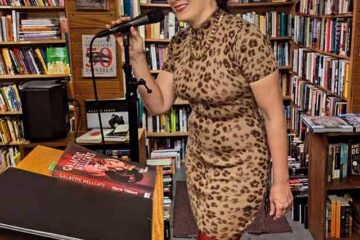
I despise hand-selling my books. The whole reason I’m not a self-published author is I want someone else to do that. The shame is painful. The embarrassment. I feel exactly how I used to feel when my mom would ask strangers for money.
So it was something of a surprise to leave Big Ohio Book Con and not hate myself? It hit me the next day, as I was walking my dog, feeling mostly recovered from 16 hours of “working retail again, but worse, because selfish.” I was relating the experience to my bestie on the phone and thought, “huh. I don’t hate myself. What’s different?”
What Was Different
Let’s take stock and analyze it. I want to recreate this next book fair!
Pre-Planned Strategy
My past book fair tables contained pretty much anything I could think to throw in a box: Freebies, candy, fliers, decorations. I brought my silver rocketship-shaped cocktail shaker to FanExpo and put it next to Geoff’s books with a little “Hugo Winner” sign.
Last year, I sat at a table next to a guy who had only written book one of a proposed trilogy who sold his whole stock while I sold 2 books. His was also science fiction. His premise was kinda… been done. He didn’t have anything on his table but a nice, professionally-printed sign. He wore a suit.
Between the two of us, who looked like the desperate newbie who might not be that good? Me, that’s who. All my handmade stuff and blinking lights screamed “pick me last for your team.”
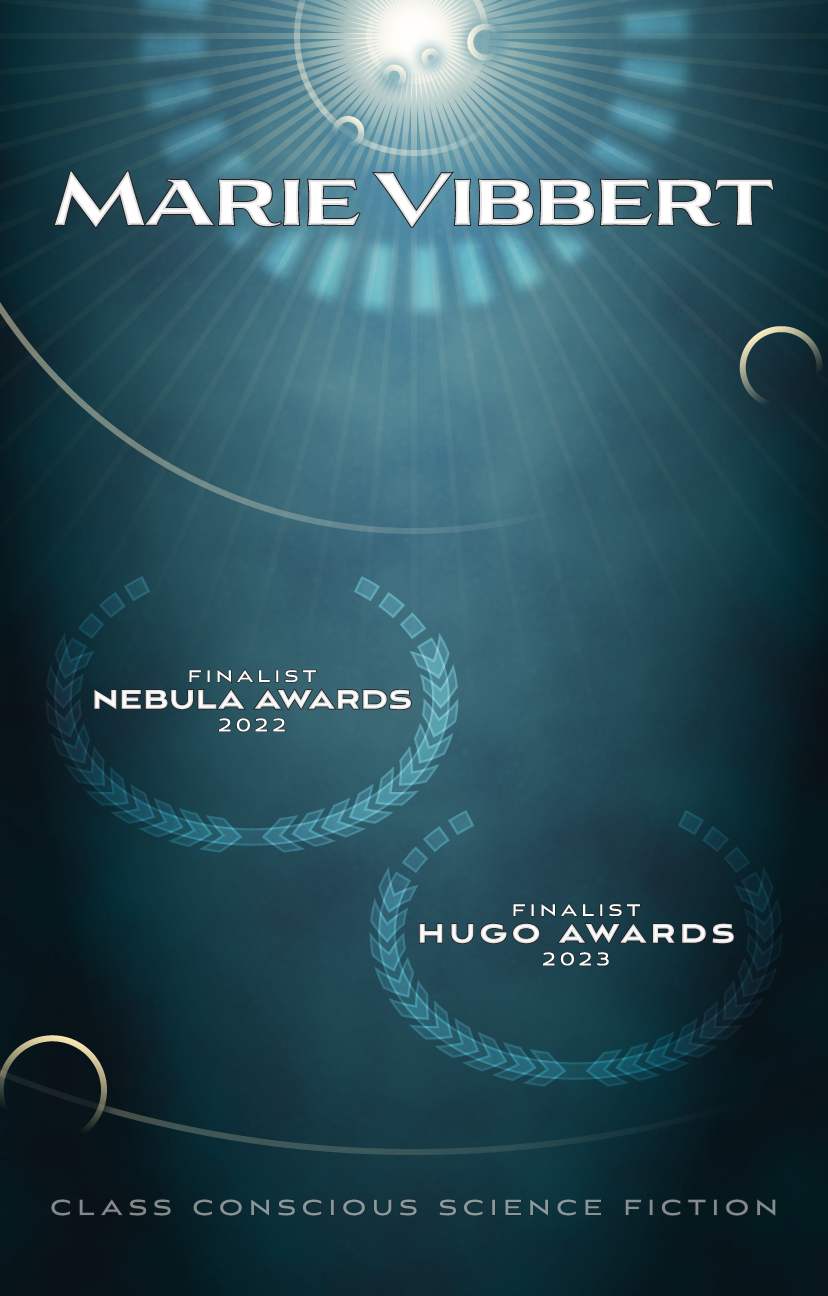
SO. I decided to cosplay suit-dude. I was going to dress professionally and have a mostly-bare table. I had my spouse, Brian, who is actually good at art, make me a pretty sign that showcased my biggest bone fides: my Hugo and Nebula nominations.
Then I went to Goodwill and bought a black satin blazer. I tried it with various shirts under it until I found a good look. I wore my hair up and even put on make-up.
No give-aways. No hand-made anything visible.
(Okay, I still used my scrap-fabric table cloth, but it’s really pretty fabric, and people complimented it.)
Having a plan felt good, proactive, and putting it in order kept me nicely busy before the event so I didn’t overthink.
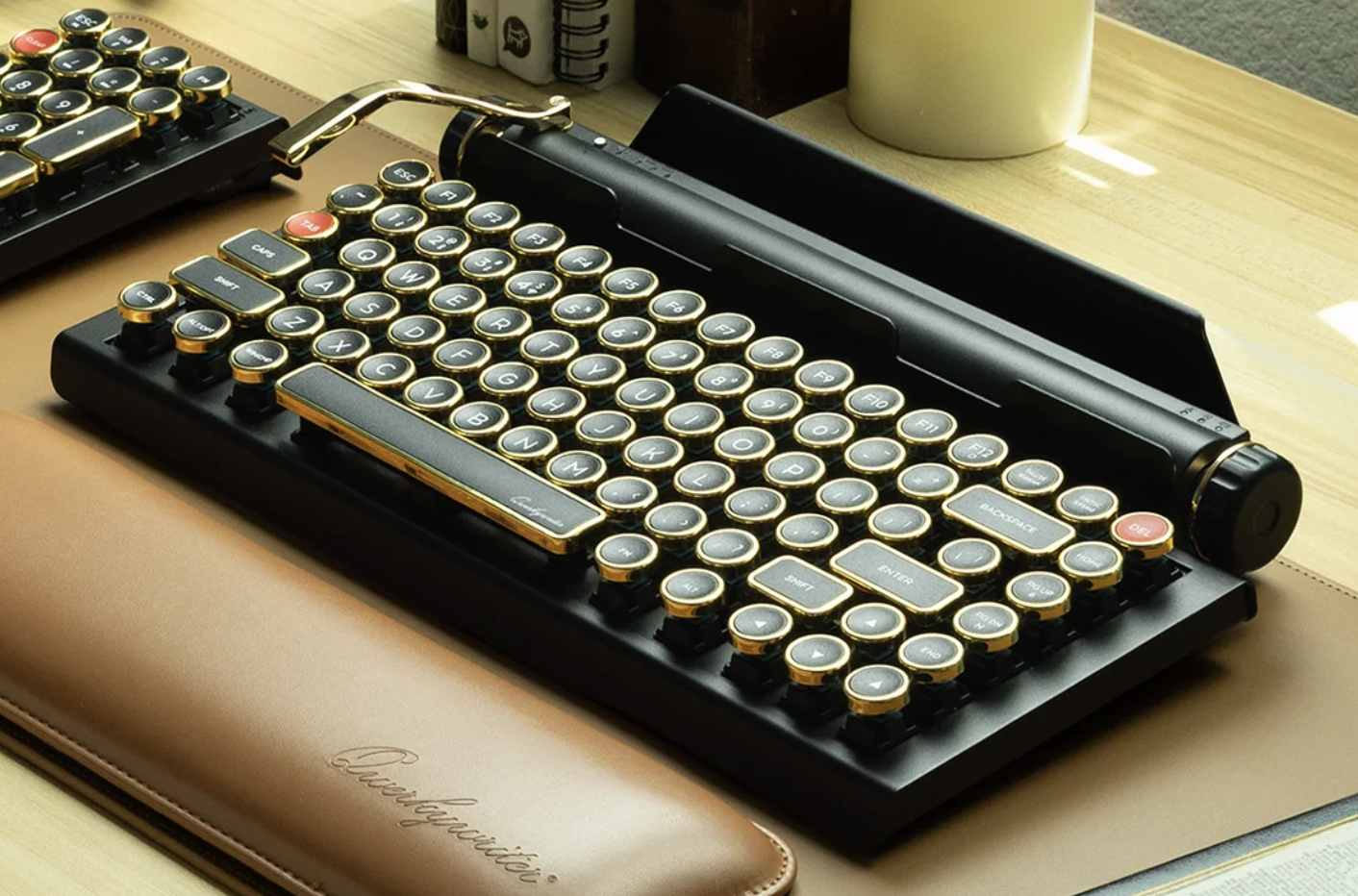
Qwerkywriter
I had been toying for a while now with an idea to use my Qwerkywriter mechanical bluetooth keyboard and an iPad for my newsletter signups, making it more appealing to do. I’ve had this plan for over a year, but Qwerkywriter wasn’t working. (I tried EVERYTHING. I took it apart. I changed out the battery. I changed the power cable. Finally, I contacted the company support line. They asked me if I’d turned it on.
I… work in IT. I’ve re-wired keyboards on LAPTOPS. I…
I had forgotten this thing had an “on” switch. Two seconds later, um… it was working.)
ANYWAY. My first two hand-selling events, I had a notebook and a pen to sign up for my newsletter and I got 8-10 signups, and then found out I could only read 6-8 of the addresses well enough to sign them up. My next event, I brought the iPad by itself and had people sign up that way, which worked great and I got about 12 sign-ups.
Friends, the Qwerkywriter drew newsletter signups like I was giving away tickets to Disneyland.
“Sign up for my newsletter and get a free ebook.”
“I don’t really check my email…”
“You can play with the typewriter?”
“I’M IN!”
I got 89 newsletter signups! An order-of-magnitude record for me. Also, the sleek keyboard drew eyes and made people look at me, which is half the battle.
Did a lot of people come up just to talk about my typewriter keyboard and then not stay to talk about books? Yes. Does that matter? I reminded myself, silently, that studies show people are more likely to come up to a table that has someone at it. We see it’s popular. We want in on the popular thing. So what if the popularity is for the decor and not the product?
I know, now you want one. Here’s the company’s webpage. Sad news: you won’t get it as cheap as I did kickstarting them years ago. But clearly they last, just remember there’s an on/off switch under the knob on the side.
Eye contact
A friend had told me the most important part of hand selling was to make eye contact with people. I found, contrary to what I would have guessed, that if I made eye contact and then made a ‘come here’ gesture, almost everyone did come up to me.
How had no one shared this complicated and completely secret, unknown trick with me?
I did some laps of the event when I could get away from my table, and I noted the body language and expressions of the other authors. Many were visibly nervous, or crouched low over their phones. The ones who made eye contact and were also relaxed made me want to talk to them. Ah, I thought. I see, now.
Basically: be someone other people will want to talk to. (Yes, that sentence sparks panic in my heart, too, but there’s more. Let me explain in the next section.)
Sell by Not Selling
Going in, I gave myself a hard talking-to about trying too hard. No one wants a hard sell. They’re books, not timeshares in Florida. I even toyed with using “Don’t buy my books” as a leading line.
“You aren’t here to sell,” I told myself. “You are here to find readers, maybe even friends. Treat it like you’re networking at a work event. If you sell anything, that’s a bonus.”
It worked. It forced me into a more relaxed pose, like the people I found easier to approach on my own laps. Some of the people I beckoned over, I really did start with, “Don’t buy my books. Just talk to me. How’s the con for you? Find the books you’re looking for?”
The “Don’t buy” disarmed and relieved people. They stayed and chatted, and many of them bought. Giving myself permission to be silly and awkward made it a lot easier on me, too.
Late in the convention, I chatted a good long time with a woman starting with, “Just rest your bag here, I promise not to pitch my books to you unless you ask.” She did, and we chatted about our mutual love of books and disquietingly large “to read” piles. She was primarily interested in romance, and that was cool. I explained that I was all science fiction. I waved her over to the person next to me selling romance, and she bought one of her books. Then she came back and read the backs of some of my books. She asked a few questions, which lead randomly to talking about Marvel movies, then she thanked me and went on her way.
Yes, I felt a little worried I’d missed an opportunity. A little let down. BUT, about twenty minutes later, she came back and bought TWO of my books.
I never felt like I was trying to sell to her, but of course I wanted to. I felt at a few points in our conversation this anxious urge to segue to the pitch, but no! I had promised! Good thing that I had. I might not have sold those two books if I’d been more aggressive, and I’d have hated myself. How lovely that not pitching both made me feel better about myself AND worked?
Success doesn’t feel like success: Wait to judge
I had a phenomenally successful Big Ohio Book Con. I sold out of my copies of Galactic Hellcats, more than doubled my table fee in profit, had some very good conversations, and got a record number of newsletter signups! I could not have asked for a better return on my investment and time.
I did not know this at the time. At the time, I was fighting back a constant worry that I wasn’t selling enough. At the end of the convention, I thought I did okay, but not great. I was certain everyone around me had sold more books than me. I had to get home and check my bank balance and the wad of twenties in my bag to realize I’d done not just good but damn good.
Some of this is our old friend, greener grass on the other side of the fence. I only noticed other vendor’s sales, their dwindling stacks, not their long times standing in boredom. I definitely noticed MY long times standing in boredom, and had more free brain cells during those times to catastrophize than I had time to celebrate during the frenzied sales.
People walked right past me. People were visibly repelled by me, afraid they were going to have to endure an unwanted sales pitch. That happened. That always happens. But I also had one person come to the table, snatch up Multitude and say, “I love it. I’m getting this, just from the cover.” And three people came with their already-purchased copies for me to sign. Two dear friends stopped by, and they both wanted something signed, too.
We can’t help that we see the negative so much clearer than the positive, that 80 compliments are undone by one criticism. The important thing is to not let yourself focus on that negativity. This particular day, I did a good job of recognizing when I was about to whine and pity myself and backing off.
Honestly, I did it by remembering a previous good-sales day. “You felt this way at FanExpo. Exactly like this, and you whined and complained, and in the end you made more money than ever before, and then didn’t you feel embarrassed to have been so whiney before?”
I’m not sure that’s completely healthy self-talk, but it worked for me. I respond well to guilt.
In Conclusion
The biggest part of this was my mental state. Not focusing on sales numbers. Trying, in fact, NOT to pitch. Remembering to be grateful just to talk to people. Focusing on the positive. Give yourself permission to just be. Did I sell absolutely as many books as possible? No. Is that a reasonable goal to have? HELL NO. In the past, it had been a secret goal in the back of my brain; I felt I had to do the most possible, sell the most possible, be the most possible. That’s some garbage thinking. This time, I dropped the thoughts the moment I realized they were creeping in, and it made my day, and my sales, better.
Next, having an interesting, professional-looking table. I didn’t have freebies out at all. I kept my bookmarks behind the stacks of books and handed them to people who asked for a business card.
Qwerykwriter will be following me to the next event, for sure.
As will Brian’s sign. It worked. Three or four times, I saw people who were walking by without interest stop when they read the sign. Their eyes widened and I could hear them think, “Oh, this author is probably good.”
At past events, I had a sign that said “Hugo and Nebula nominated author!” that was printed on my home printer and stuck in an acrylic holder. Only once do I remember someone commenting on it. Form does matter as much as function. Sadly, people are only interested in you if you’re already successful, and a professional, more-expensive printed sign says success in a way an amateur one doesn’t.
Finally, don’t over-sell. Under-sell. Try to be real. Yes, I had pre-prepared ‘elevator pitches’ but I changed them up so I came off unrehearsed. I was, as much as possible, unrehearsed.
Few people like direct sales, but it’s part of the business. Better to prepare for it. I hope this helps someone.